

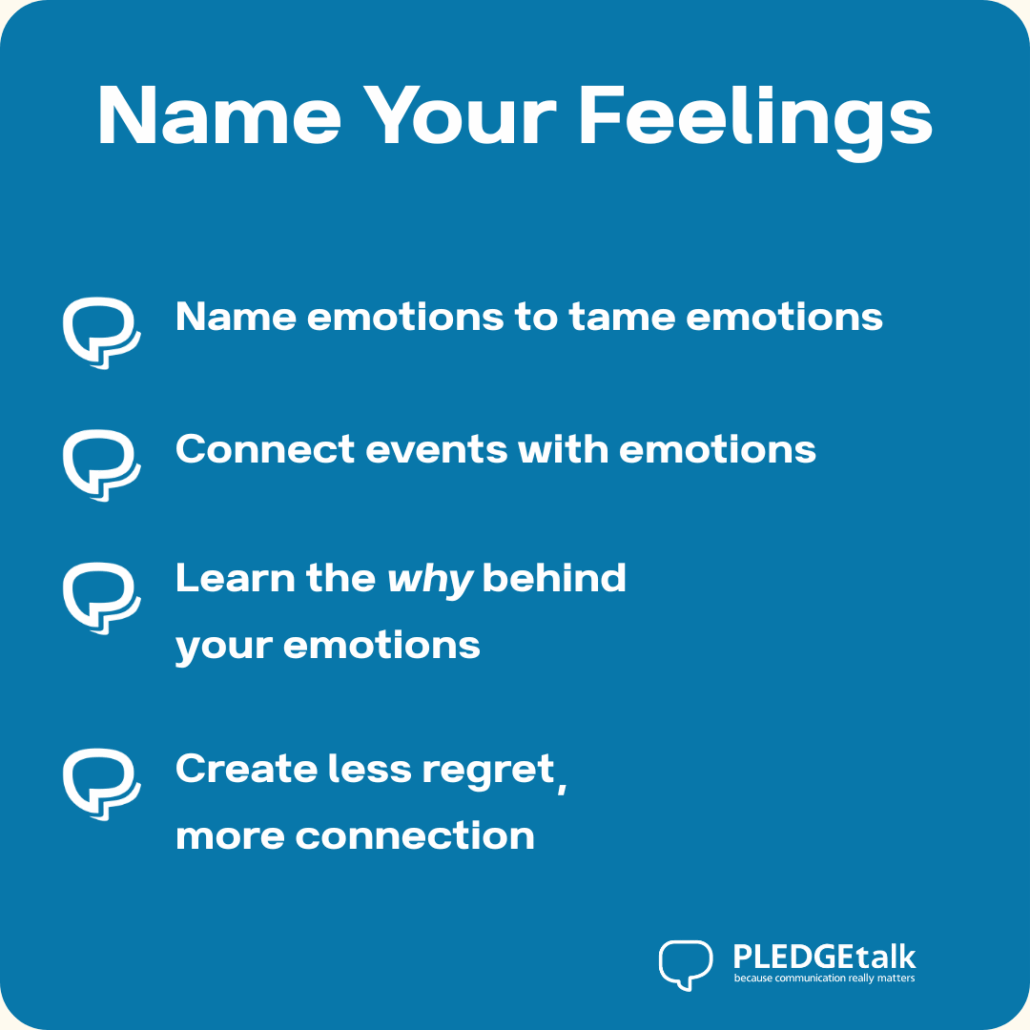
Name It to Tame It: The Simple Secret to Calmer Conversations
Ever had a conversation with your spouse (or anyone close to you) that went south fast?
One minute you’re talking, the next your blood pressure’s climbing, and words are flying that you wish you could take back.
Here’s a simple, science-backed tool that can stop that downward spiral: Pause. Name it. Tame it.
Step 1: Pause for 90 Seconds
In my last post, HERE, I shared how hitting the “pause button” for just 90 seconds when you feel a strong emotion gives your body time to cool off. Those 90 seconds allow the adrenaline surge to fade so your brain can think clearly again.
Think of it as a reset button for your mind.
Step 2: Name What You Feel
Dr. Daniel J. Siegel, clinical professor of psychiatry at UCLA and co-author of The Whole-Brain Child, coined the phrase “name it to tame it.” His research shows that labeling your emotions—whether you’re a child or an adult—can actually calm the brain’s fight-or-flight response.
When you name your emotion, you begin to tame it.
It’s not magic—it’s neuroscience.
Why Naming Works
When you name your emotion, you start understanding it.
That understanding begins to strip away its power over you.
Example:
Your spouse interrupts you mid-sentence. You feel your shoulders tense. You blurt something sharp that you regret. You’re left wondering, Why did I react like that?
Later, you replay the moment. You realize they spoke out of turn. They didn’t let you finish. They assumed they knew your point and cut you off, saying you were wrong. What were you feeling?
Maybe it was irritation. Or frustration. Or just plain anger.
By giving it a name, you connect the dots between what happened and how you reacted.
The Marriage Superpower
This “naming” habit gives you the power to:
- Understand why you’re feeling what you feel, and respond the way you do.
- Reduce emotional overwhelm.
- Choose a better response next time.
The result? Less regret. More connection.
Weekend Challenge:
Next time emotions run high:
- Pause & breathe – Give yourself those 90 seconds.
- Name it – Choose the word that best describes your emotion(s).
- And if you choose, share it – Tell your spouse or friend, “I’m feeling frustrated,” instead of launching into attack mode.
The more you practice, the easier it gets—and the calmer your conversations will become.
💡 Remember: Strong marriages aren’t built by avoiding emotion. They’re built by handling emotion well!
To help, I am including a diagram that lists the names of various emotions you might feel:
 |
Name Your Feelings, Lead Your Life!
In my next posts, we will further discuss a course of action for what to do after we feel and name our emotions.
That’s all for now!
Mark Oelze, Author/Creator of PLEDGEtalk
Learn more at PLEDGEtalk.com


Leave a Reply
Want to join the discussion?Feel free to contribute!